Australia’s data centre and power boom
AEMO now expects data centres to use seven times more electricity within a decade. Here’s where they’re going, who’s queuing to plug in, and who pays.
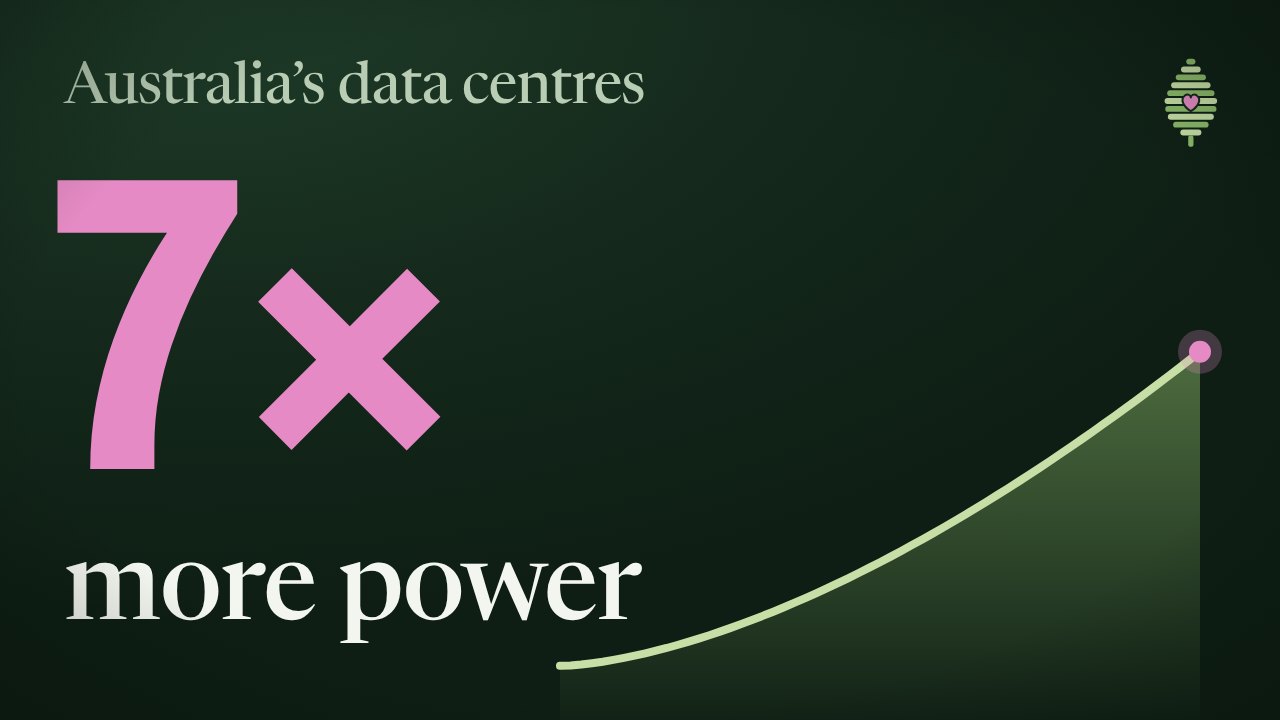 8:10
Watch the film · 8:10 · music only, sources on screen Chapters
- 0:00 Intro
- 0:15 Right now
- 0:45 The forecast
- 2:03 The queue
- 3:05 Where and why
- 3:58 The money
- 4:54 The catch
- 5:46 The global race
- 6:33 The new rules
- 6:53 What to watch
- 7:23 The numbers to remember
Right now
About 165 data centres are connected to Australia’s main electricity grid, the National Electricity Market that runs down the east coast and across to South Australia and Tasmania. Together they used roughly 5 terawatt-hours of electricity in 2025–26, around 3% of everything the grid supplied.
One 100-megawatt data centre running flat out all year uses about 0.9 TWh. So today’s total is roughly five and a half of those, running around the clock. Origin Energy now says data centres are the main driver of electricity demand growth.
The forecast
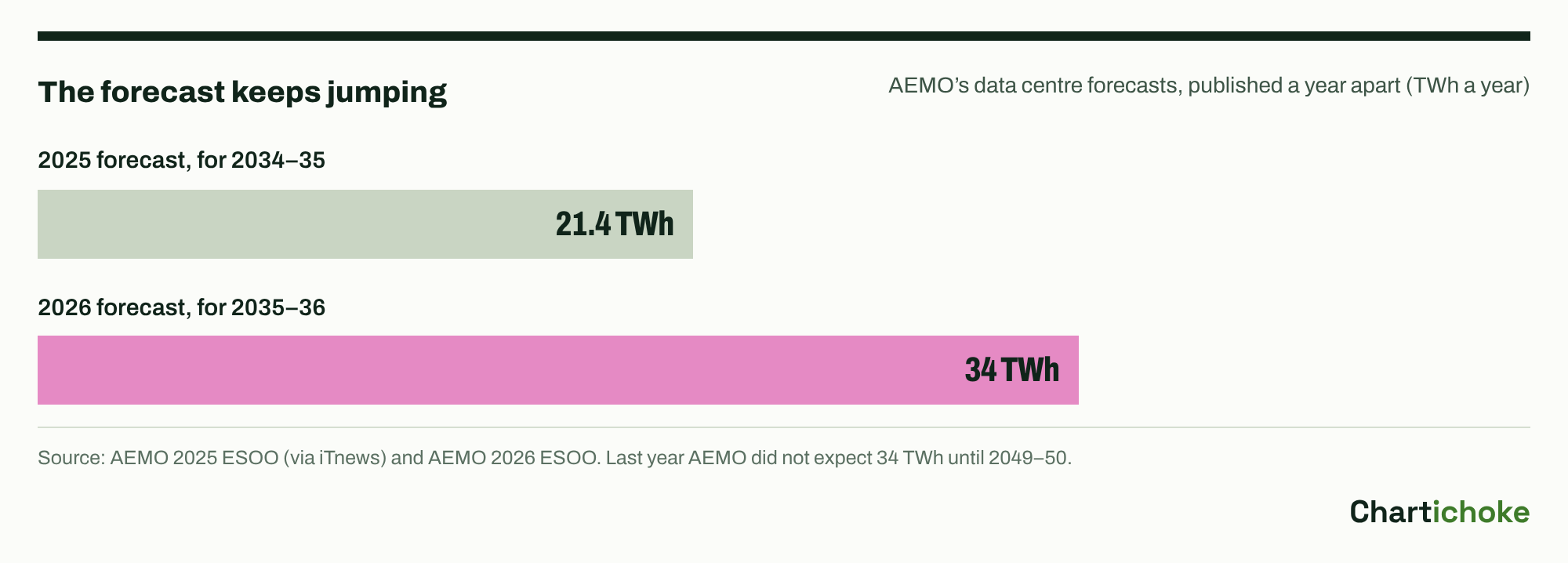
In August 2026 the Australian Energy Market Operator published its new ten-year outlook. Its central forecast has data centres using about 15 TWh by 2029–30 and about 34 TWh by 2035–36: seven times today, and about 13% of all grid electricity.
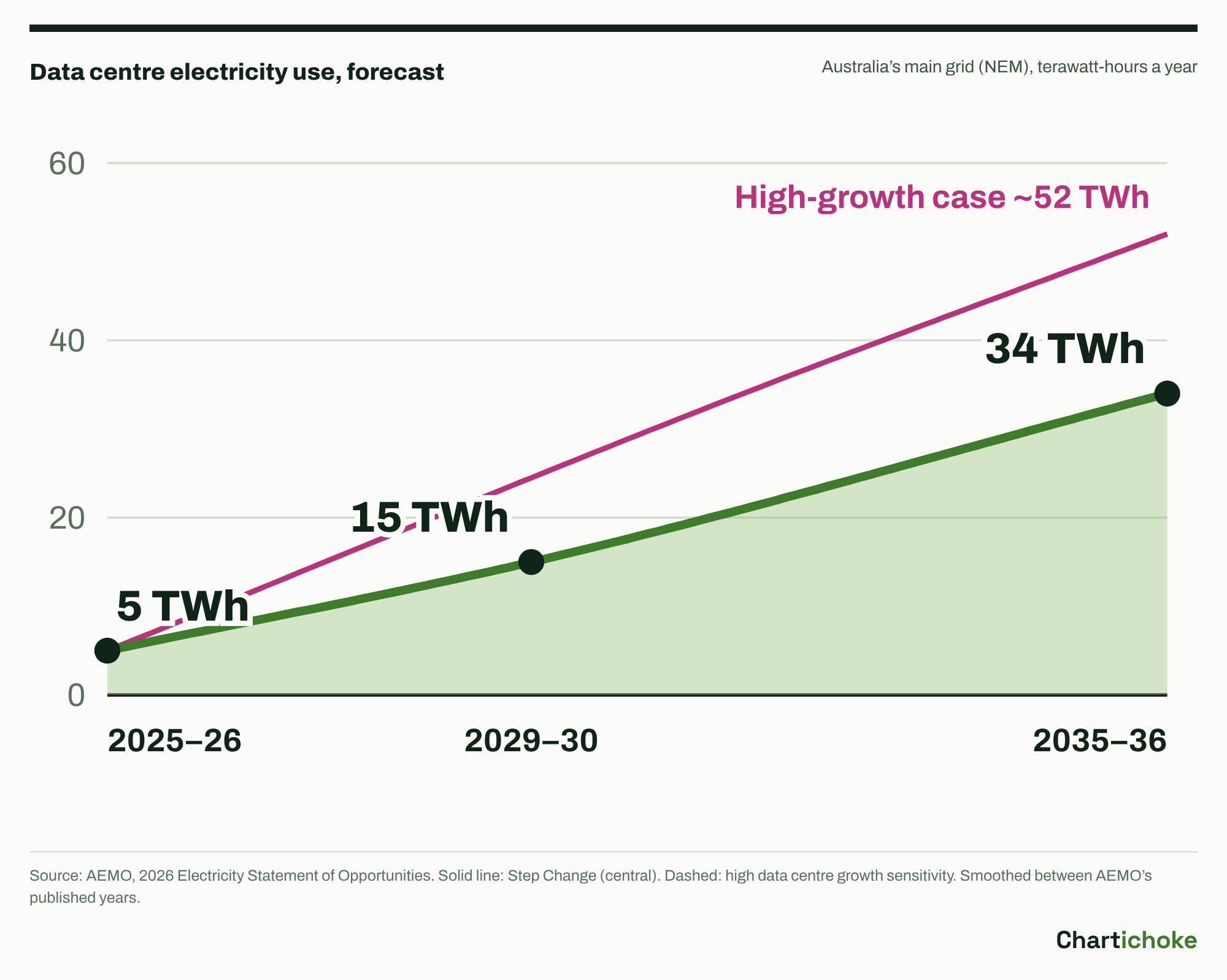
The number has moved fast. A year earlier, AEMO expected about 21.4 TWh by 2034–35 and didn’t see data centres reaching 34 TWh until 2049–50. The same milestone has arrived fourteen years sooner in a single revision. If growth runs hot, AEMO’s high case reaches about 52 TWh.
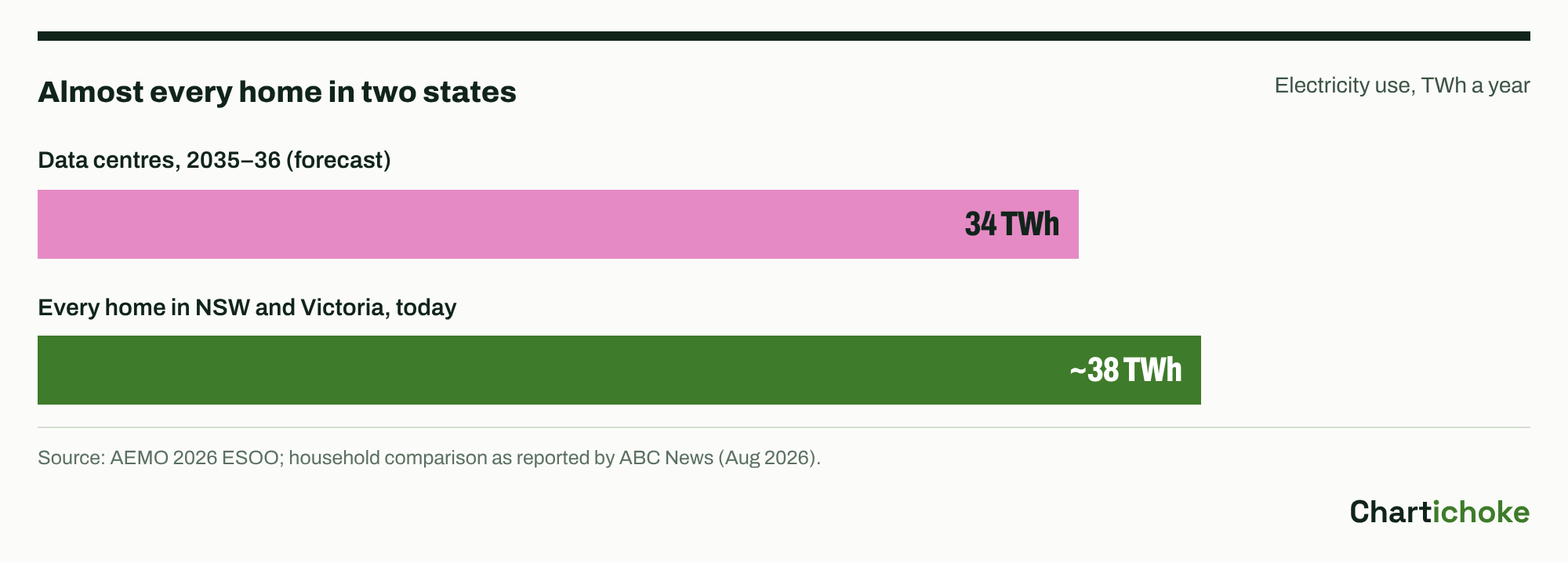
For scale: 34 TWh is close to what every home in New South Wales and Victoria uses today, about 38 TWh. It’s the equivalent of roughly 38 sites of 100 MW, each running all year.
The queue
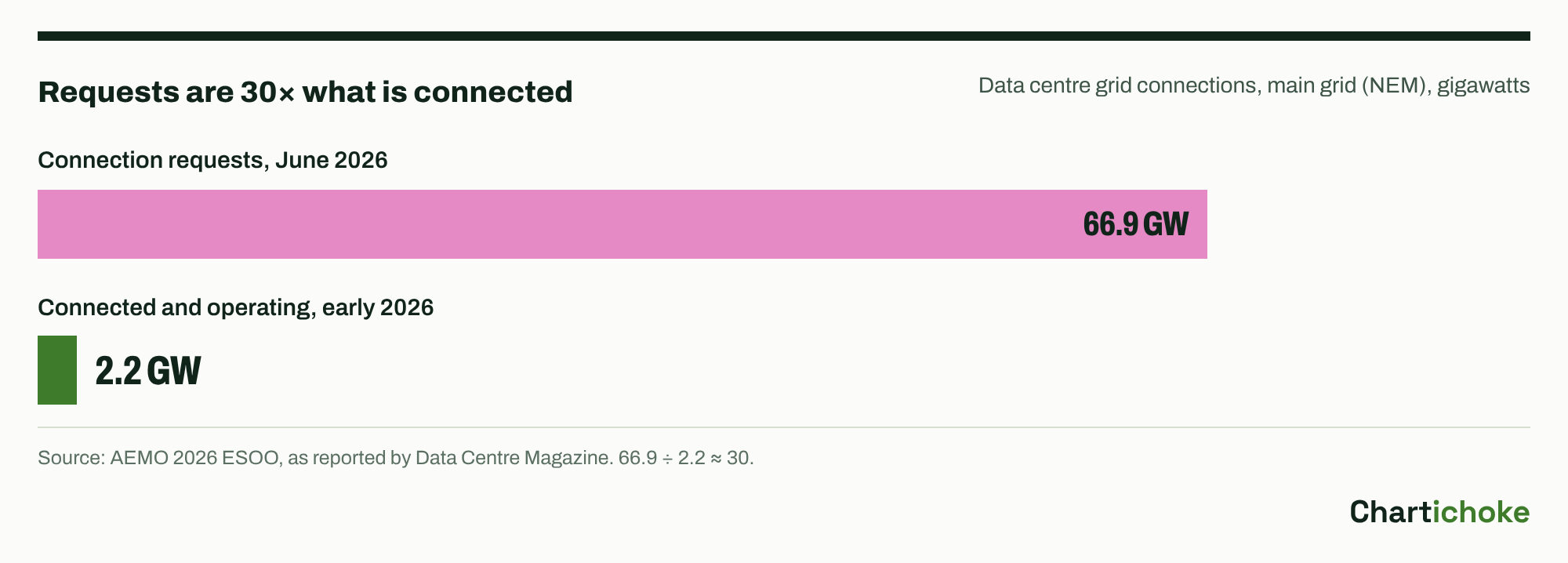
Wanting power and getting it are different things. Data centres have asked the main grid for 66.9 GW of connections. Only 2.2 GW is connected and operating, so requests are about thirty times what exists today.
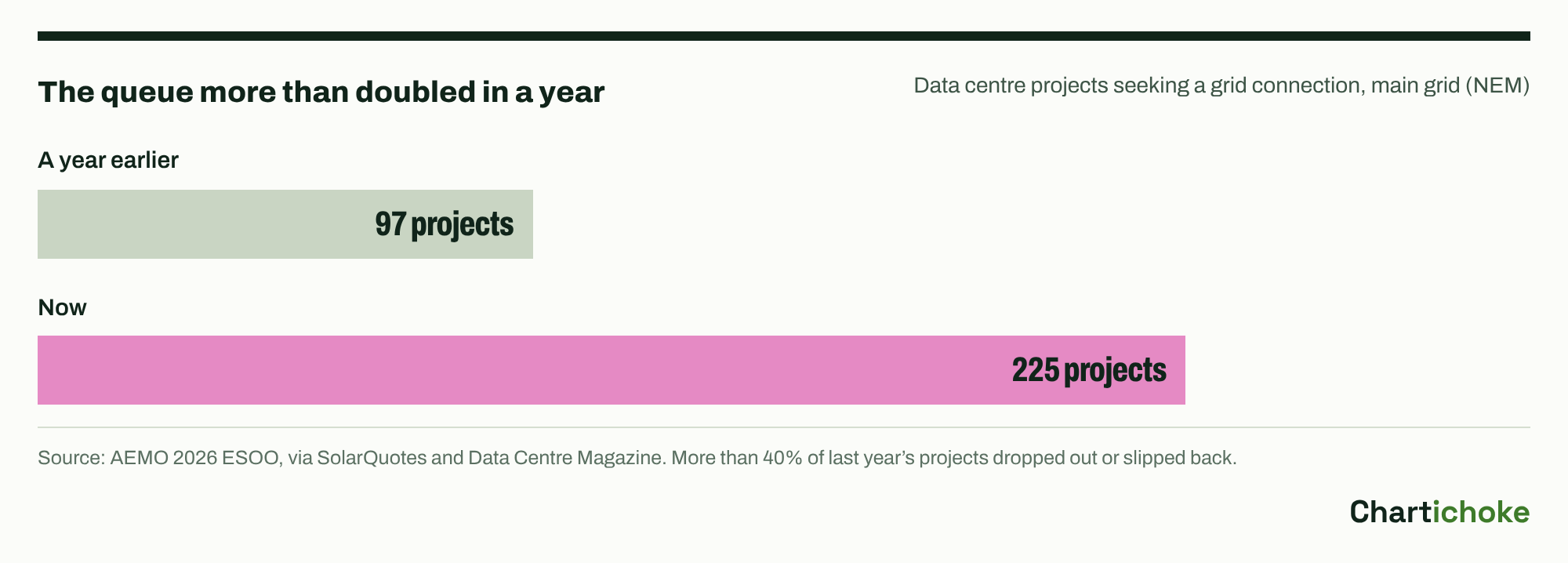
The queue is also churning. It holds 225 projects, up from 97 a year earlier, but more than 40% of last year’s projects dropped out or slipped back. And operating sites currently draw only about 27% of the connection capacity they hold; AEMO notes new sites can take five to ten years to fill up.
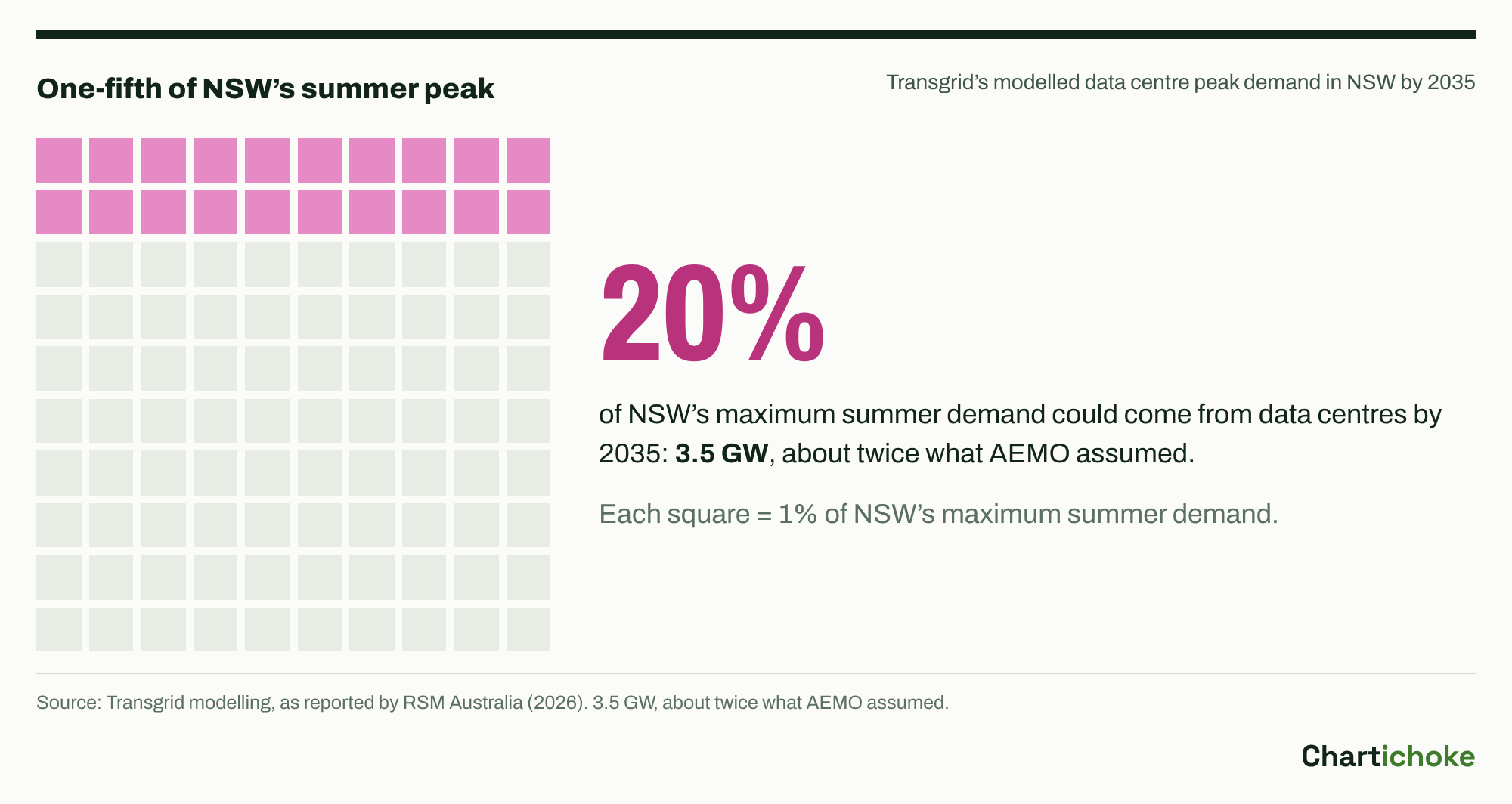
New South Wales alone has 28 GW of data centre connections sought, with 13 GW already in advanced talks. Transgrid’s own modelling sees 3.5 GW of data centre peak demand in the state by 2035, about twice AEMO’s assumption.
of NSW’s maximum summer demand could come from data centres by 2035: 3.5 GW, about twice what AEMO assumed.
Each square = 1% of NSW’s maximum summer demand.
Where and why
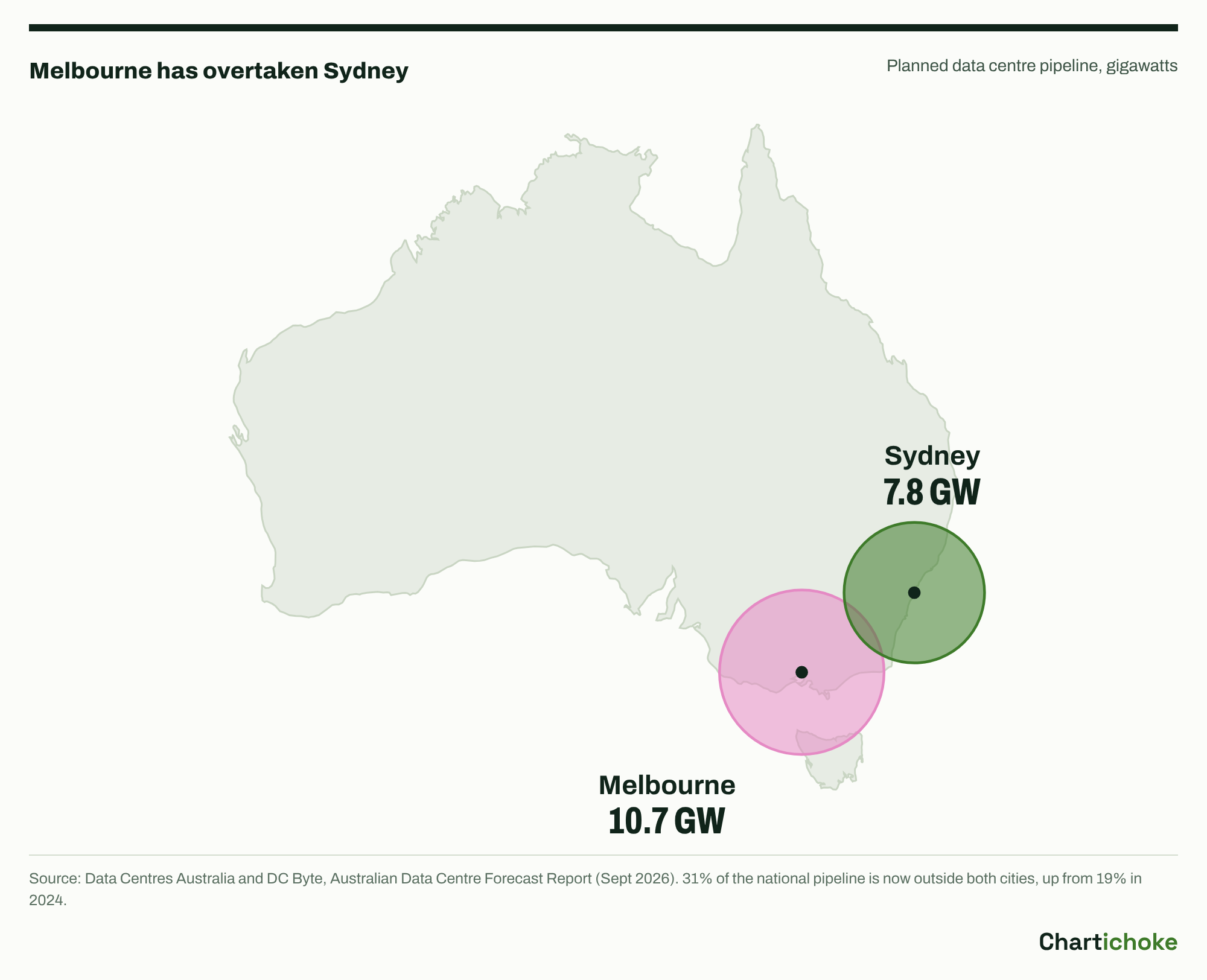
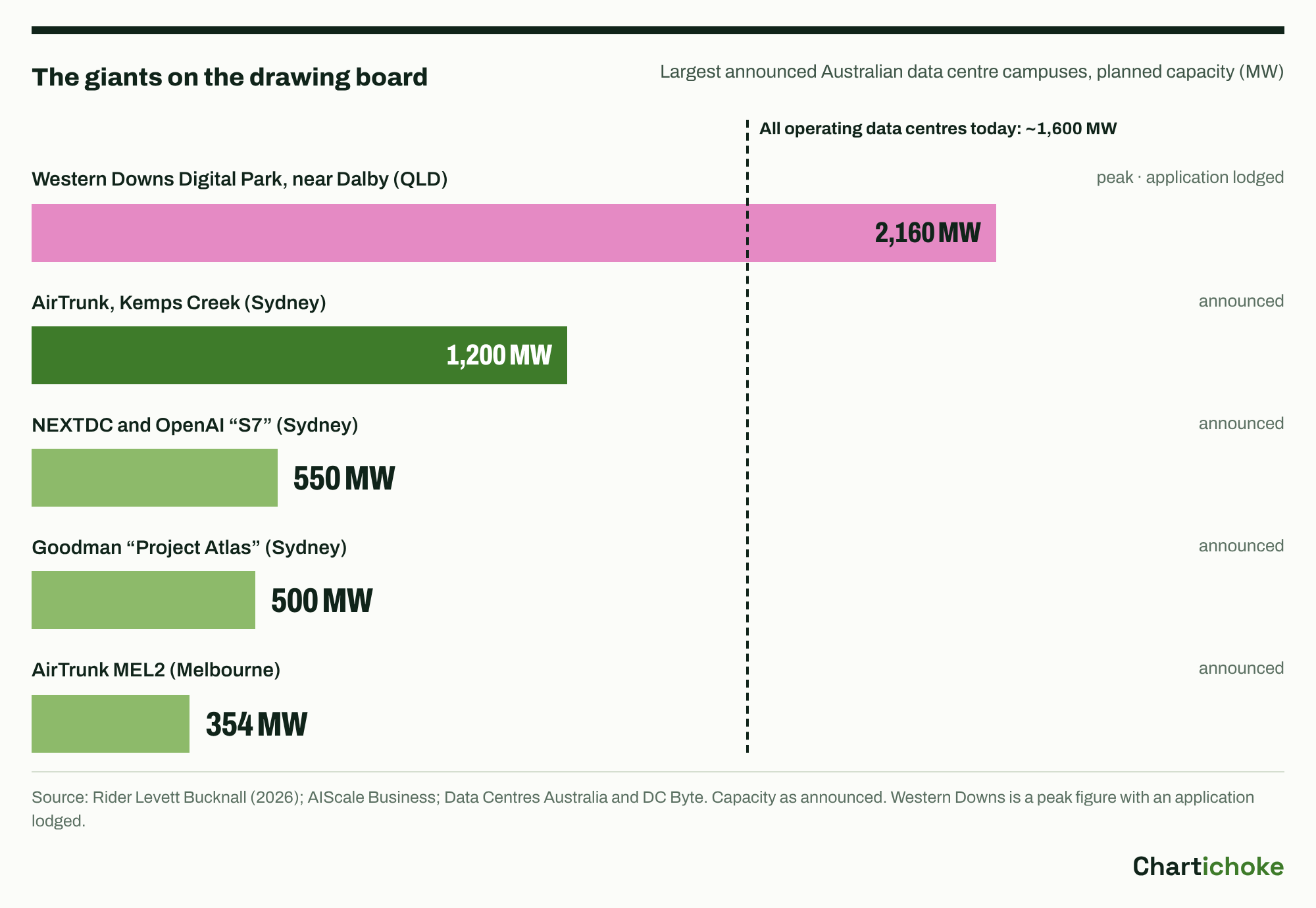
Australia’s operating data centres add up to about 1.6 GW across 163 facilities, forecast to reach 3.9 GW by 2030. The planned pipeline has a new leader: Melbourne, at 10.7 GW, has overtaken Sydney at 7.8 GW. And 31% of the pipeline now sits outside both cities, up from 19% in 2024.
Australia ranks third in the world for current and planned data centre capacity, behind the US and India. The draw is political stability, land, links to Asia and abundant renewable energy. Google, Apple, Meta, Amazon and Microsoft are all reportedly eyeing new AI data centres here; Microsoft alone has committed A$5 billion. Construction commencements are up 800% in three years, mostly in Sydney and Melbourne.
The money
In January–March 2026, about 17% of all private investment in Australia went to data centres: the biggest share in records going back nearly two decades. The Australian Bureau of Statistics pointed to “investment in data centre equipment, specifically server racks.”
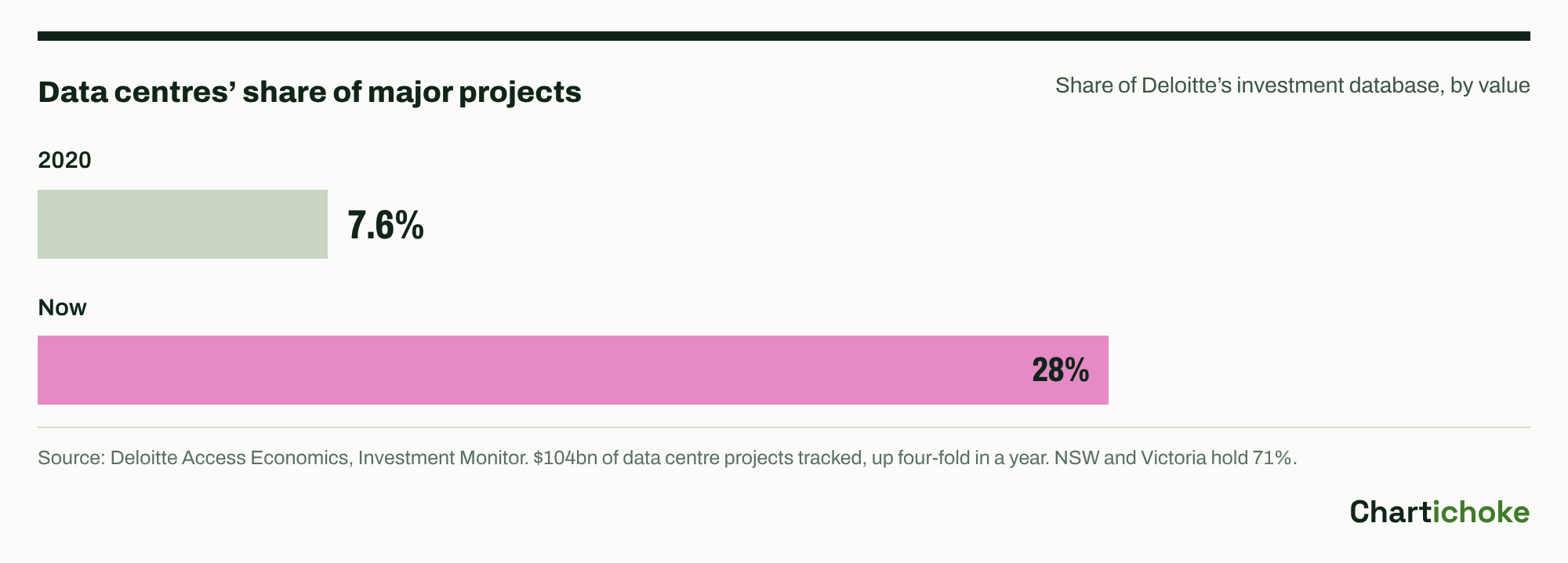
Deloitte Access Economics now tracks $104 billion of data centre projects, up four-fold in a year. They make up 28% of its major-projects database by value, against 7.6% in 2020, and NSW and Victoria hold 71% of it.
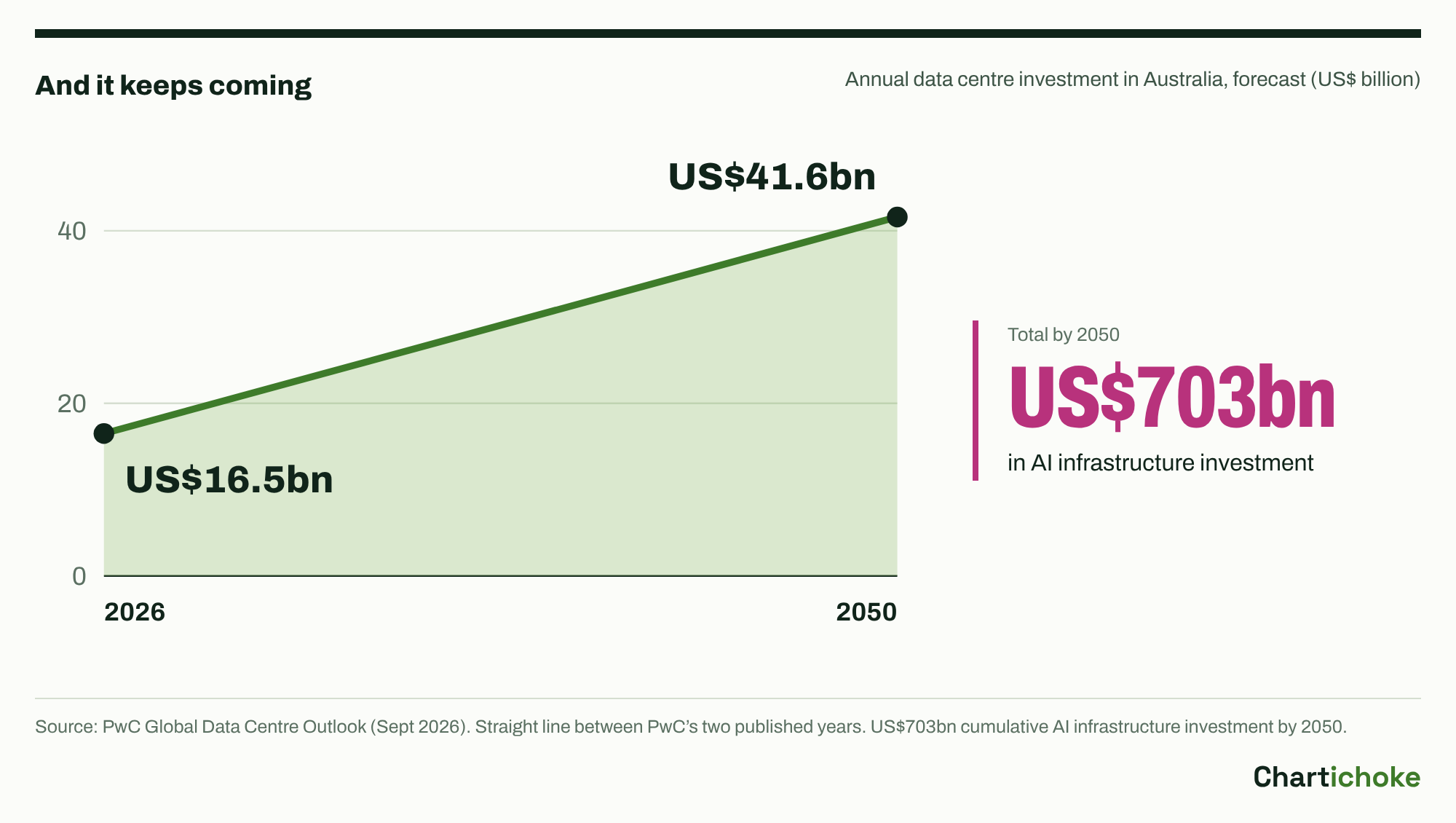
The estimates of the total vary with what’s counted. CommBank sees a $150 billion investment opportunity by 2030. Westpac puts the pipeline at $155 billion or more, about 5.6% of GDP. Mandala Partners estimates at least $26 billion of new infrastructure to 2030. PwC expects annual investment to climb from US$16.5 billion in 2026 to US$41.6 billion by 2050.
The catch
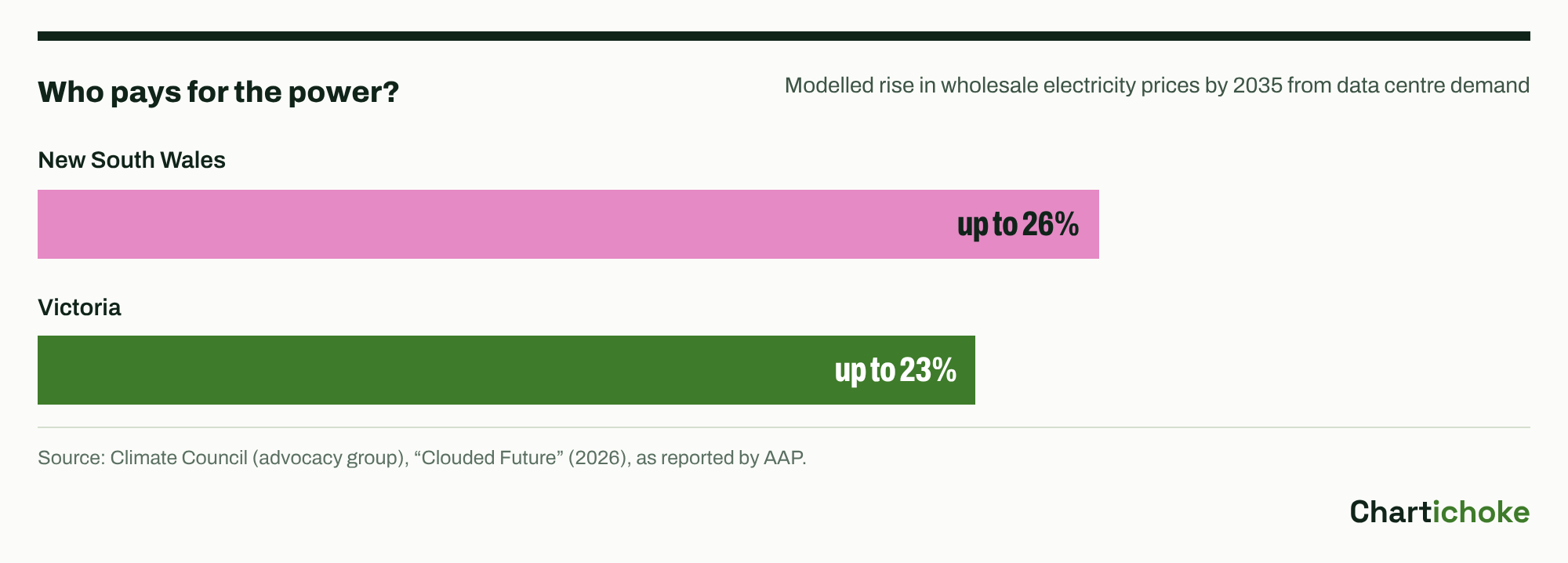
Someone has to pay for the power. Modelling for the Climate Council, an advocacy group, finds data centre demand could lift wholesale electricity prices by up to 26% in NSW and 23% in Victoria by 2035. It also reports data centre power use nearly doubled in Victoria and rose 18% in NSW over the past year.
Then there’s water. A Sydney Water forecast, cited by the Climate Council, has data centres using 15–20% of Sydney’s water supply by 2035, in a city that has spent almost half of the past 20 years in drought. In Tasmania, more than 10,000 people signed a petition calling for a pause on new data centres, enough to trigger a parliamentary inquiry.
Can the grid keep up? AEMO’s answer, for now, is yes. A record 9.1 GW of new generation and storage connected in 2025–26, another 40 GW is committed or likely by the early 2030s, and AEMO forecasts no reliability gaps before 2030. The catch: that only holds if the new supply is actually built on time.
The global race
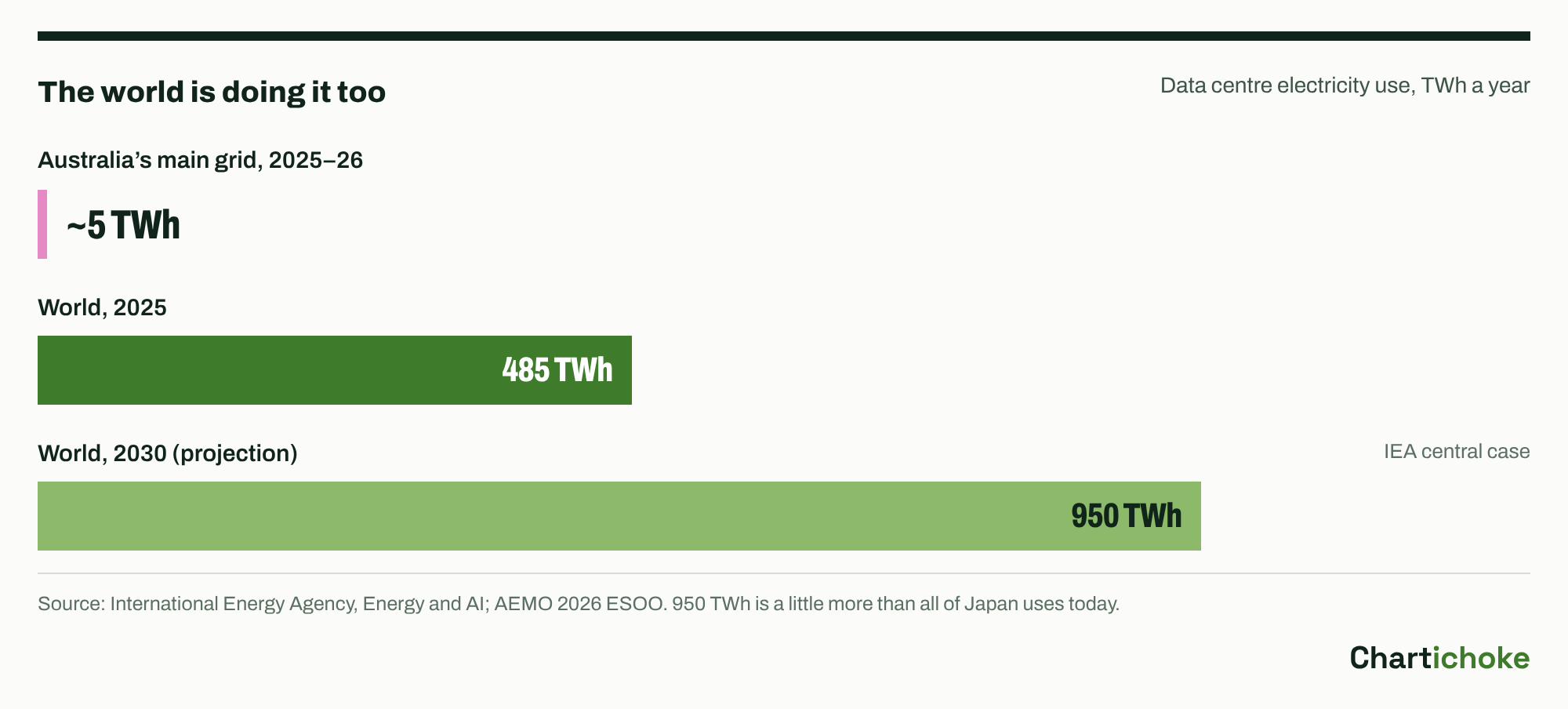
Australia is one small part of a worldwide build-out. Data centres used about 485 TWh of electricity globally in 2025, up 17% in a single year, according to the International Energy Agency. Its central case reaches about 950 TWh by 2030, a little more than all of Japan uses today, with AI-focused data centres tripling their use.
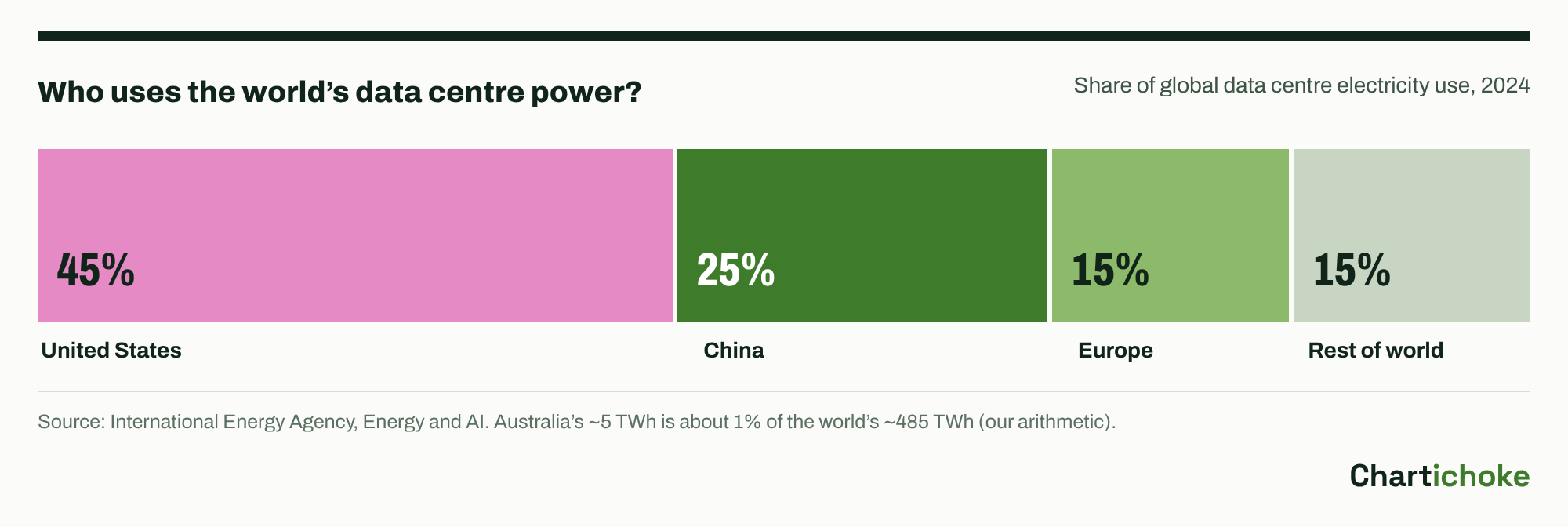
The United States used 45% of the world’s data centre electricity in 2024, China 25% and Europe 15%. Australia’s ~5 TWh is about 1% of the global total. AirTrunk has said that pushback in the US is steering big tech towards building in Australia (paraphrased).
The new rules
In July 2026 the federal government announced that big data centres must become net generators of renewable energy. Under the plan:
- The rules apply to sites using 30 MW or more.
- Sites must put at least as much power into the grid as they take out.
- They pay their full share of grid connection costs.
- They cut demand when the grid needs it.
- Queensland and the Northern Territory won’t be forced to mandate renewables.
Legislation is due in early 2027.
What to watch
- Will the queue convert? More than 40% of projects dropped out or slipped last year.
- Can Sydney’s grid cope? Transgrid sees 3.5 GW of data centre peak demand by 2035.
- Will water rules bite? Sydney Water expects data centres could need up to 15–20% of supply by 2035.
- Will Queensland go its own way? It won’t be forced to mandate renewables.
Sources and method
Forecasts are labelled as forecasts. Advocacy groups are named as advocacy groups. Paraphrases are never shown as quotes. Our own arithmetic is shown under each chart. Every chart can be downloaded as a PNG and its data as a CSV, free to republish with credit.
- AEMO, 2026 Electricity Statement of Opportunities (media release)
- AEMO, 2026 ESOO data centre forecasting overview
- iTnews, AEMO predicts seven-fold rise
- Data Centre Magazine, AEMO 2026 ESOO
- SolarQuotes, data centres and power bills
- Data Centres Australia and DC Byte, forecast report
- W.Media, pipeline shifts beyond Sydney
- Rider Levett Bucknall, data centre boom
- AIScale Business, pipeline report
- Tech Insider (Bloomberg), US tech giants and Australia
- TechRepublic (ABS), investment boom
- Deloitte Access Economics, Investment Monitor
- PwC, AI infrastructure to US$703bn
- AAP, Climate Council “Clouded Future”
- Energy-Storage.news, net generator rule
- PV Tech, state requirements
- ACS Information Age, renewable plan
- International Energy Agency, Energy and AI